Thursday, March 24, 2011

The Kelly Kettle!

Considering buying one of theses for the coming camping season. Also, designing a larger, water heater sized version for use in the floodplain project.


This video is hilarious! So Irish!

Assignment 5 - Flood Plain Minimum Dwelling

Coming into the final stretch here, seeing the mounting challenge of building a model for this thing, and still not being wholly sure of most of the interior components. So how did we get here? 


I'll try my best to re-cap. Traditionally the floodplain is not inhabited it is usually lived adjacent to, and sometimes is farmed, due to the natural cycles of flooding the plain offers very soft, fertile soil, excellent for agriculture, terrible to build on. Our first explorations looked into floating houses, on poles, or anchored with a retractable winch, then we looked at stationary, more substantial structures like bridge abutments. Both of these options seemed less than exciting, and posed significant questions all based around the basic "but why" inquisitions. The questions led to the why would stay in the flood plain, if its floods anyways? Why couldn't we just leave?

Early American cultures thrived in the flood plains of rivers. It is a location where the resources needed to sustain life are readily available, fresh water passes nearby, game and fish travel along them. Sometimes the river was also their sole mode of transportation. The early native North Americans did not stay there, their homes were temporary, easily picked up and moved and they travelled with the changing seasons. They moved south when the snows came in the winter, and travelled back in the spring to follow the migrating herds.

We deiced that a mobile architecture was needed to address the ebbs and flows of the river. The concept is to find a robust, off-road vehicle that would allow us to travel into the flood plain, and design a comprehensive dwelling on top of it. This would allow us to dwell for the temperate seasons within is abundant, secluded, remote setting of the floodplain and be able to pick up and leave when things get hairy. 


We started by looking at amphibious vehicles, APC's LARC's, ARGO's, Duck trucks, you name it, we were looking for an accessible platform we could build on. We eventually settled down to the UNIMOG, for sale to the general public, imported from Germany, designed and built by Mercedes. The UNIMOG isn’t an amphibious vehicle but it is capable of fording water up to 1.2m deep without a snorkel.


A Mercedes Unimog is the tool of tools. It is a cross between a transport truck, a Jeep, and a tractor. Weighing in at 9900 lbs with a payload capacity of 15,900 lbs and towing capability of 45,000 lbs the Unimog is the strongest 4x4 vehicle available to the general public. It is capable of incredible steep climbs and descents, plus it is an incredibly handsome piece of equipment.


Here is an informative promotional movie of these things in action. 


Wednesday, March 16, 2011

A Mill for Sale!

Last week I discovered an old Grist mill for sale North of Port Hope, this past saturday we drove to check it out.


The Property is only 1/2 acre and, like most mills, is located in a flood plain. It doesn't have a septic tank or potable water or three phase electricity. When we arrived we more than excited, for multiple reasons, it was a shed, hanging out over the water, and all the components were clearly visible. We snooped around back the building and took in the wonderful decay, its multiple repairs and its current state of decomposition.


The Turbine location. The flow control gate, and axle and drive shaft are all exposed to the weather. There is also a massive ice sculpture that has formed over a crack in the penstock.


We met with the real estate broker and he showed us around, gave us some numbers on mill, he said it has an average flow of 1800 gal/s, and an 18' head between the damn and the turbine (which we measure to be 16).  He also showed us inside and we got a peek at the old roller machine that the owner used for grinding grains and making custom animal feeds. This thing is a really awesome piece of history.


 We left the site more than a little excited at the proposition of owning a little hydro mill.

Tuesday, February 22, 2011

A Museum of Early American Tools - Axes!

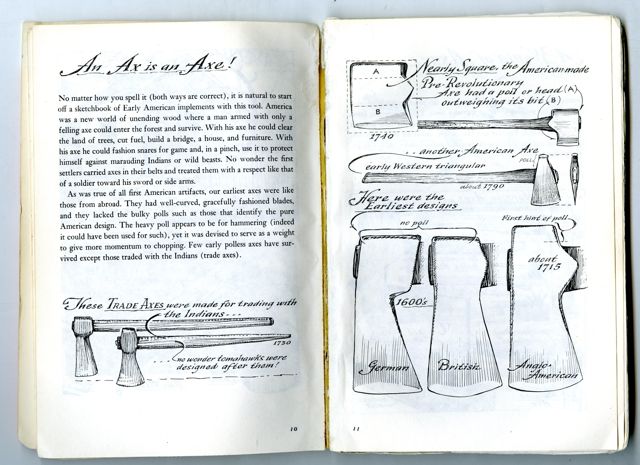
I recently discovered this great book A museum of Early American Tools by Eric Sloan. The book features loads of hand drawn pen and ink illustrations of all kinds of tools used by early American settlers. Tools for barn building, black smithing, carpentry, you name it all hand drawn and explained. I wanted to scan the entire book, but instead I've decided to order my own version (hardcover) from amazon. For a little taste of how awesome this little book is here is the first few scans All about Axes.


If you want a copy, click Here

Monday, February 21, 2011

Same Blog New Name

Welcome to the new, shorter Axes and Mills.

I will continue posting my academic (and non academic) explorations, research and assignments.

Enjoy,

-D

Thursday, February 17, 2011

Assignment 3 - Biograph - Part 1 - Time


Paper route

Between 4:00 am and 6:30 am from about 1998 until 2001 I had a morning routine. When I was twelve I became delivery boy for the Brantford Expositor the local newspaper. I was responsible for the delivery of three hundred and twenty papers each morning. The route was too large for me to do on my own and I had to enlist the help of my father. I asked him formally, but since the route was his idea first, I knew he would accept. We would deliver about a hundred and sixty papers each, every morning and would split the earnings down the middle. It was hard to tell who worked for whom.
I would set the alarm, usually at 4:00 am, 3:30 if it was a Friday. I would get up and brush my teeth. Then I would wake my Dad and make go downstairs to make myself Breakfast, usually a glass of milk and two toasts with peanut butter. My Dad would be ready to leave in ten minutes or less. He wouldn't eat anything.
Under complete darkness we drove five minutes to the downtown depot to pick up the papers. Sometimes we waited in the car for the delivery van to show up, while other mornings our pile was waiting for us when we arrived. Fridays, Saturdays, and sometimes Wednesdays we had inserts, advertisements, catalogs, etc. Depending on how cold it was we would usually put the inserts into the papers on the hood of the car. Our family car was a 1980’s Ford Crown Victoria, it had a very large hood. I would stand on the passenger side and fill my bags, and he would fill his on the other. When it was cold I would climb into the back seat to do my half, my dad would do his half on the front seat. On insert days we needed three bags each, one at each side, and one on our backs.
We each had our own side of the street. Sometimes we covered for each other if one of us fell behind. My dad is 6’2” and I was maybe 5’6” then, he walked fast and I had to hustle to keep up, unless he had trouble with a mailbox he usually covered for me. We walked through snowdrifts and rain, sleet. We felt the crisp spring mornings, and the fresh summer dawns. I knew where I was each morning, I knew my task, I knew how to avoid motion lights and whose steps were the slipperiest, I anticipated each crack in the sidewalks.
The route had 4 stages. We did the largest first, carrying the most weight right away. During the spring, by the end of the first stage we would begin to see the morning light peeking up in the East. The end of the first stage was my favorite time each morning, I would run the last three papers to the end of the street and my dad would wait for me at the corner. We would walk back to the car together. We never talked of too much, but we did talk, mostly he drilled me about school and I asked him questions about cars and life, sometimes we complained about the weight of the papers or the weather. Most of the time I was just happy to be outside with him while no one else was awake.
The second stage was a small dead end street. It was also the last street the city would plow during the winter. Which is to say that it never got plowed. There was more than a few mornings when I had to push the car out of a snowdrift. . I had to be careful not to push on the lights or the front grill as I rocked the car back and forth, my dad timed in with the gas peddle. We always got it out.

The seasons then were gradual to me, the light changed slowly, as did the cold. As fall came and winter set in I would need more clothes, then scarves, hats, heavy gloves and then snow pants and long johns. During the winter we did the route entirely in darkness with just the orange phosphorus streetlights casting gloomy shadows on the fresh snow.  After the first five houses my scarf would be frozen solid and my dads beard would be white with icicles and frost. The third stage the route wound to the east of the neighborhood and ran beside a large park with. Here the wind whipped across the expanse of soccer fields and built snow drifts in front of peoples front doors and up their steps. Due to the weather making us late at every stage, sometimes my dad would have to leave for work, and I would be left to finish the remainder of the route myself. These mornings I had to carry double which was ok because I had time before school and I could go at my own pace. One blustery morning, more than 12 inches of snow had fallen already, I remember this morning because I remember trudging through the drifts and having the wind coat my front white as I walked. I would step forward and the wind would whip behind me, my tracks were quickly blown over and covered, as if I was never there. The papers just appeared in those mailboxes with no trace of the boy who carried them.
The last part of the route, we would do in the daylight of summer, but in the fall and spring the sun would just be rising and we hurried as not to be seen. We would get back into the car and drive up the hill to the last 6 or 7 houses. My dad would turn off the headlights as we pulled into the driveways. I would run to the mailboxes while he turned around the car. If we were done the third stage early we would walk to these distant houses together carrying only a few papers under our arms. Some Saturdays after the route was finished we would go out for breakfast, just him and I at the local diner.

He would order eggs and chocolate milk. I would get the same.  

Assignment 3 - Biograph - Part 3 - Thing

1994 Pontiac Grand Prix

It’s red, red, with black mirrors, and black widows. The inside is tan, with cloth seats, and a black consol, with a black radio. The wheel was low, and through it you could see the gauges clearly, emblazoned with an orange glow from deep beneath the dash. In front of me under the long sweeping hood purrs a fuel injected 3.1L V6. The exhaust runs beneath my feet, and produces a low throaty note behind me. My foot feeds the fuel into the engine and it responds, the power is delivered directly into the front wheels and my vessel moves forward.
Minutes ago I bought it outright for a thousand dollars. I paid cash in twenty-dollar bills. My friend had given me the tip that his neighbour, the previous owner of this machine, wanted to sell. It was Pontiac Grand Prix, a modern muscle car trying to fit into a domestic suburban society. I am happy to rescue it from this falsity.
I pull out of the crescent, and onto the parkway. My hand slides over the wheel, the steering responds instantly as I weave left and right through the slow afternoon traffic.

A week before I made an agreement with my father that I would drive the family van until university. That would have been a good deal if the van actually made it that long. The van was a two-tone blue GMC Rally, with chrome running boards, a roof rack and a special edition grille. It was hard to guess that the old crate had a 350 cubic inch V8 with a stainless steel exhaust. It ran with a loud tick when we bought it used three years ago. We have done a terrible job maintaining it ever since. The tick got gradually worse every time my dad lit up the tires in front of the factory where he worked. Thumbing his nose and the bosses 911 turbo. Then two days ago as I was driving to Orangeville in the high morning heat the engine blew. I lost all power and barely limped it off the highway.

It’s hot. With one touch from my left hand index finger I roll down the window. The hot summer air feels cool as I cruse through town. When I stop at a red light the heat seeps in. I reach down and turn the radio on. I adjust the side mirrors with my left hand, then reach up and position the rearview. The seat is perfect.

We see out mechanic every Sunday at church, I paid for the van to be towed from Burlington back to his shop. It was Saturday and the shop was closed, but he met me there anyways. He popped the hood of the van, and turned the key, after a few tries if fired up. He gave it a listen and turned it off, He looked at me dead straight, “broken piston rod, maybe a cracked manifold” he paused,  “it would need a full rebuild maybe a whole new block” thinking, adding, he finished with, “a new engine, before labour, three or four thousand” I knew labour would be at least another grand and he confirmed my guess “Labour would be at least three full days from one man, minimum fifteen hundred”. He had said enough. The rebuild was worth twice what we had paid for it. The Van was dead.

My dad is close behind me, watching, judging, I drive cautiously but efficiently hearing his words echo in my head: “Do as I say, not as I do”. I signal and make a right onto the number 18 concession and drive out of town. The black and white speed limit signs read 80 now and accelerate to suite. I drive west into the hot afternoon sun, flip the visor down to shade my eyes. I’ve never had or appreciated air-conditioning so I open all the windows with my fingers on my left hand.  Approaching my turn, I signal left to turn onto Onondaga road, another half mile to our mechanic. My dad pulls up close behind me and sticks his head out the window and yells something. I didn’t hear him. I make the turn and wait for him. He comes close and yells again. This time I hear him, I grin and my foot pushes down on the gas.
“Let her go!”
As I put down the accelerator I watch him get smaller and smaller in the rear view mirror. I watch the Tachometer move through each of the 5 speeds, always shifting effortlessly just before the 6000rpm red line. I look down at the speedometer, mind meets adrenaline and I read speeds I’ve never dreamed of in the van. The car sinks low to the ground hugging the road. The concession bends around a long gradual turn I hold the wheel steady with both hands, cutting inside over the right white line. Confidence builds, coming out of the turn I accelerate again to a higher speed. Pushing the pedal down and I keep finding more power beneath my foot. The engine revs higher. The radio is gone, the engine and the wind is all I hear.
The shop driveway comes up fast and I brake hard to make it. The wheels grip the hot summer pavement, the hood drops, and the seat belt holds me close into seat. I lean in as I jolt the wheel right, pulling into the drive with the smell of hot brakes and burnt rubber close behind me. I leave the keys with the mechanic as my dad pulls up.

The old van is still sitting where the tow truck left it.